Showing posts with label Alan Hollinghurst. Show all posts

Saturday, February 19, 2011

Writing a Party Scene/ Creating a Crowd

Your character might be driving a carful of kids and dogs to the annual family clam dig, or he might be wandering through Munich's town square at Oktoberfest—either way, the challenge for the writer is the same in both instances: how to introduce multiple people in the same scene.  Most novels (and many short stories) probably have at least one scene in which the main character is but one of many.   There's almost always a group get-together of some kind or another—a family meal, a party scene, a dash through a crowded airport.  

This morning I began working on a scene from my novel in which a group of five guys shows up unexpectedly at my protagonist's front door.  Only one of the five are important to my story (and to my protagonist) but  the fact that that this visitor arrives with an entourage is significant.  My first attempts at writing this scene were not very successful.  When I focused on introducing the significant visitor first, the other four almost disappeared entirely. On the other hand when I attempted to keep the other four characters in view, the focus veered clumsily away from the conflict between my two main characters.
           
With a little research I discovered the answer to my dilemma in Janet Burroway's Writing Fiction, A Guide To Narrative Craft:

“Sometimes it’s necessary to introduce several or many people in the same scene,  and this needn’t present a problem, because the principle is pretty much the same in every case, and is the same as in film: pan, then close-up.  In other words, give us a sense of the larger scene first, then a few details to characterize individuals.... We will believe more thoroughly in large numbers of people if you offer example images for us...." 


"If you begin by concentrating two long on one character only, we will tend to see that person as being alone."

Pan, then close-up.  Pan the five guys who show up at my protagonist’s door, then focus the camera on the two who matter most.  Sounds pretty simple. 

But what if I want to write a large dinner party into my story? How do I juggle all those guests, their comings and goings, their different groupings, and snippets of conversation?

According to Burroway the same technique is used for both:  pan first, then zoom in for the close up.  But if the scene goes on for several pages or an entire chapter how do we keep the crowd from disappearing after that initial "pan"?  In that case a single pan at the beginning of the scene will not be enough to keep the reader aware of (and believing in) the crowd we've created around our main characters. We will need to zoom in and out more than just the one time at the beginning of the scene.  In The Line of Beauty by Alan Hollinghurst, the reader follows protagonist Nick Guest as he arrives at a very large party: 

Drinks were being served on the long terrace, and when he came out through the French windows there were two or three small groups already laughing and glowing.  You could tell that everyone had been on holiday, and like the roses and begonias they seemed to take and hold the richly filtered evening light.  Gerald was talking to a somehow familiar man and his blonde-helmeted wife; Nick knew from his smiles and guffaws that he was being recklessly agreeable.  None of his particular friends was here yet, and Toby was still upstairs with Sophie, interminably getting dressed.  He took a flute of champagne from a dark-eyed young waiter, and strolled off into the knee-high maze of the parterre.  ...The curlicue of the path brought him round to a view of the house again, but the waiter had moved off, and instead he saw Paul Tompkins ambling towards him.

Later, when the guests are seated for dinner, we drop into the middle of a conversation between Nick and the two people sitting beside him, then pan out briefly to get a glimpse/feel of the room as a whole, before finally returning to the close-up conversation between the three:

"So what's he like?" said Russell.  "Her old man.  What's he into?" He glanced at Catherine, across the table, before his eyes drifted back down the room to Gerald, who was smiling at the blonde woman beside him but had the fine glaze of preoccupation of someone about to make a speech.  They were in the great hall, at a dozen tables.  It was the end of dinner, and there was a mood of noisy expectancy. 
            "Wine," said Nick, who was drunk and fluent, but still wary of Russell's encouraging tone.  He twirled his glass on the rucked tablecloth.  "Wine.  His wife…um…"
            "Power," said Catherine sharply.
            "Power…" Nick nodded it into the list.  "Wensleydale cheese he's also very keen on.  Oh, and the music of Richard Strauss--that particularly."

Throughout the scene the author reminds us again and again that Nick and his friends are not alone in a bubble but part a crowd seated at “a dozen tables.”  He accomplishes this by having Nick pan the room every now and then giving us the opportunity to glimpse other guests at distant tables, and to interpret their gestures and hear snippets of their conversations. We hear the group laughter and even catch a peek of the servants watching from the gallery above. In between these occasional faraway glimpses we return to focus up-close on Nick’s thoughts, his immediate surroundings, and his conversations with those beside him:

            Nick pushed his chair back to get a clearer view of Gerald, and also of Toby, who had colored up and was looking round with a tight grin of apprehension…  Nick grinned back at him, and wanted to help him, but was powerless, of course.  He was blushing himself with the anxiety and forced eagerness of awaiting a speech by a friend….
           
            Through the generous laughter Nick caught Toby's eye again, and held it for two or three long seconds, giving him perhaps a transfusion of reassurance.  Toby himself would be too nervous to listen to his father's speech properly, and was laughing in imitation of the others, not at the jokes themselves…. Nick surveyed the room, and was reminded of a college hall, with Gerald and the more influential guests elected to the high table.  Up in the arcade of the gallery one or two servants were listening impassively, waiting only for the next stage of the evening. There was a gigantic electrolier, ten feet high, with upward-curling gilt branches opening into cloudy glass lilies of light.  Catherine had refused to sit under it, which was why their whole table had apparently been demoted to this corner of the room. If it did fall, Nick realized, it would crush Wani Ouradi.  He began to feel a little anxious about it himself….
             
            Nick glanced round, in a little shrug of amusement, and saw that the waiter from Madeira, was standing in the doorway behind him, following the proceedings with a vacant stare… He saw that Catherine was stuffing things into her bag and flashing irritable looks at Russell, who mouthed, "What?" at her, and was getting irritable in his turn.  "So, Toby," Gerald said, raising his voice and slowing his words, "we congratulate you, we bless you, we love you: happy birthday!  Will you--all--please raise your glasses: to Toby!"
            "Toby!" the overlapping burble went up, followed by a sudden release of tension in cheers and whistles and applause--applause for Toby, not for the speaker, the heightened, unreal acclaim of a special occasion, amongst which Nick lifted his champagne glass with tears in his eyes, and kept on sipping from it to hide his emotion.  But Catherine had jumped her little gilt chair back from the table and hurried out, past the waiter, who followed her for a second, to see if he could help.  Then Nick and Russell stared at each other, but Toby was getting to his feet, and Nick was damned if he was chasing after her this time, he really did love Toby, more than anyone in this high magnificent room, and he was going to be with him as he spoke. 

I apologize for butchering Hollinghurst’s beautiful prose in that excerpt.  Didn’t mean to take a machete to it, but the scene goes on for some time and I just wanted to give you a gist of what he accomplishes there.  I’m sure you have your own favorite party scenes by authors you love.  Francine Prose, author of Reading Like A Writer has a few of her own: the ballroom scene in Anna Karenina;  “the wild party that winds through so many pages of William Gaddis’s The Recognitions;” and her favorite ( I think): the party scene in James Joyce’s short story “The Dead.” 


Janet Burroway: Writing Fiction: A Guide to Narrative Craft
Francine Prose: Reading Like a Writer: A Guide for People Who Love Books and for Those Who Want to Write Them
Alan Hollinghurst: The Line of Beauty

Monday, June 21, 2010

Take Your Character to the Movies...

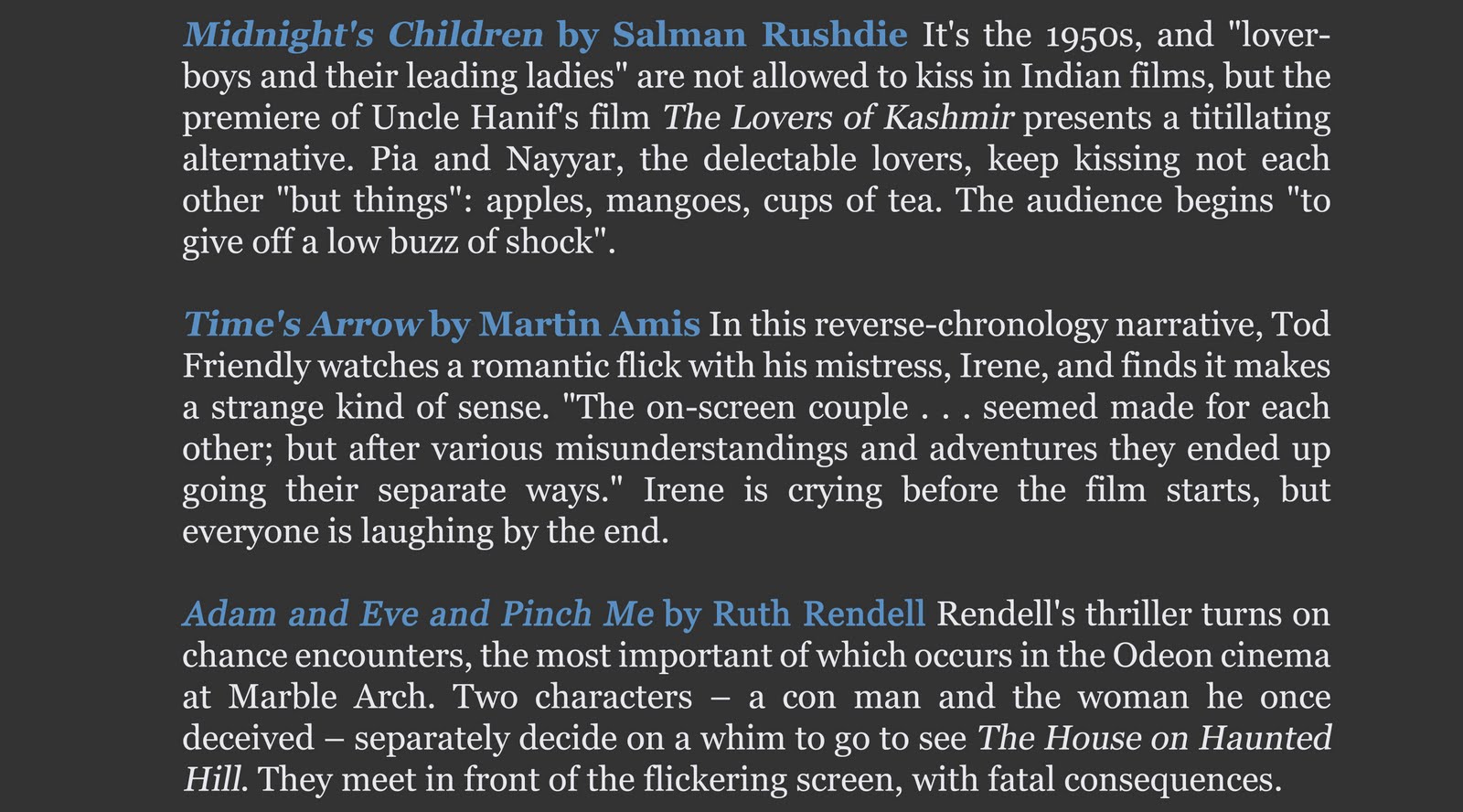
Last month, as part of his long-running "Ten of the Best: Highlights From the World of Literature" series in The Guardian, John Mullan gave us "Ten of the Best Visits to the Cinema in Literature." The movie-going characters in these scenes come to life in novels by Thomas Mann, Hermann Hesse, and Kazuo Ishiguro, to name just three.  Also on the list is the 2004 Man Booker Prize-winner The Line of Beauty by British novelist Alan Hollinghurst, one of my own personal favorites. 

So what makes these scenes so great?  And why couldn't one of our own movie-going protagonists make it onto a list like this someday?

When you read through Mullan's ten-of-the-best list below you'll notice that the scenes have more in common than just the fact that they're set inside a movie theater. The characters in these scenes act in unique and unpredictable ways, surprising the reader with their thoughts and reactions to what they see on the screen.  The characters discover things about themselves or society based on the films they see or the audience reactions to them.  The writing styles vary widely but in every passage the language sings in its own way, some crisp and others lush, but most rich in specificity and sensual detail.  Following are John Mullan's "ten of the best" and his description of each:
  
John Mullan: "Ten of the Best Visits to the Cinema in Literature" guardian.co.uk, May 15, 2010

Monday, March 8, 2010

Movement through Space

~

Here's an exercise almost everyone can use:  How to give the reader a sense of movement through space and time as your characters travel from one destination to another.  In The Folding Star,  by Alan Hollinghurst, two friends leave the city in a convertible to drive to a beach house several hours away. As they leave the city and head for the coast you can almost feel the wind in your hair and the city disappearing in the rearview mirror behind you:

I panicked again under the huge sweep of sky that opened up. The city was suddenly behind us; I looked back, and above the warehouses and estates the cluster of extravagant towers rose into view again;  they became the city; then they dwindled and were blurred in haze.  We were leaving fast, the engine was shouting, the wind tore over the windshield and whipped the hair about on top of my head. I wanted to be back where we'd come from…

There was a certain brown obscurity in the sky ahead, like rain falling out to sea.  Matt was wearing bottle-green dark glasses and frowned as he drove.  A few miles later it lifted and dissolved; and the further we went the more radiant and old-masterly the air became, so that the whole mad, worrying escapade began already to feel out of time, steeped in a dream-ether of its own.


In Jeffrey Eugenides' Middlesex, the main character describes a carpool ride to school in seventh grade:

I'm looking out the window [of the station wagon] while Mrs. Drexel's cigarette uncoils a rope of smoke.  We head into the heart of Grosse Pointe.  We pass long, gated driveways, the kind that always fill my family with wonder and awe…  We rumble past privet hedges and under topiary arches to arrive at secluded lakefront homes where girls wait with satchels, standing very straight.  They wear the same uniform I do, but somehow it looks different on them, neater, more stylish.  Occasionally there is also a well-coifed mother in the picture, clipping a rose from the garden. 

And again, a couple of months later:

The car is full of girls. Mrs. Drexel is lighting another cigarette.  She's pulling up to the curb and getting ready to lay a curse on us.  Shaking her head at the view -- of the hilly, green campus, the lake in the distance -- she says, "Youse girls better enjoy it now.  Best time of life is when you're young." (At twelve, I hated her for saying that.  I couldn't imagine a worse thing to tell a kid…"

I love how those authors show us more than just movement through a particular setting. They give us their characters' emotional reactions to the experience as well.


Alan Hollinghurst: The Folding Star
Jeffrey Eugenides: Middlesex

Tuesday, February 23, 2010

Telling Detail & First Impressions


I was re-reading one of my favorite Hollinghurst novels recently, hoping to somehow absorb through osmosis his exquisite way with language -- ah, those gorgeous sentences!  His character descriptions in particular are lovely little works of art:  lush, accurate, and insightful; and as Anton Chekhov would most likely say, "rendered with immediate and telling detail."  Even his walk-on characters come alive on the page with just a quick, simple stroke of his brush.  

In average stories minor characters and walk-ons are often easy-to-forget cardboard placeholders given little attention by their authors.  In better stories authors turn simple character snapshots into living, breathing personalities, usually by adding one or two carefully chosen "telling" details (think of them as significant, revealing, or defining details—not to be confused with "show, don't tell") as in these examples from several award-winning authors and literary giants:

 She was fifteen and she had a quick nervous giggling habit of craning her neck to glance into mirrors, or checking other people's faces to make sure her own was all right. [Joyce Carol Oates]

 His eyes were pinpoints of trouble, his mouth a flat line of pain, his shoulders so strong and high that he appeared to have no neck at all.  He entered the room as if he'd just been asked to ascend a throne and, after an initial reluctance, now meant to show just how decisive he could be. [Edmund White]

 [He was] very good company but somehow remote, the sort of person it is hopeless to fall for, as I quite did at first, with his hooting laugh and witty sentimental conversation. [Alan Hollinghurst]

 There was something very strange in him; there was a light in his eyes as though of intense feeling--perhaps there were even thought and intelligence, but at the same time there was a gleam of something like madness. [Fyodor Dostoevsky]

 There was a hint of spring in her sloe-green eyes, something summery in her complexion, and a rich autumn ripeness in her walk. [Toni Morrison]

 [He] was geeky, nerdy.  His body was a stalk supporting the tulip of his brain.  As he walked to the car, his head was often tilted back, alert to phenomena in the trees. [Jeffrey Eugenides]

 He was easily over six feet tall but appeared to regret it. [Edmund White]

 Doa Vicenta, a woman with a dull brain, who when she was not sleeping, was complaining of everything, especially the noise… [Miguel De Unamuno]

 He had on the grey suiting of a business man, but with unusual tucks and vents, which seemed to hint at his role in the arts. [Alan Hollinghurst]

 She had a radish-white, almost raw-looking body and a tiny head made big by puffed-up hair.  He never saw her out of her old torn kimono. [Edmund White]

 A priest. A young priest, black-suited, with a black felt hat, one hand stiffly in his jacket pocket, thumb hooked outside, the other holding a black breviary, finger keeping the page.  So tall, his head had a stoop. Wire-framed spectacles saddled his nose.  Oddly, ever so, foreign-looking. [Jamie O'Neill]

 She recognized most things about him, the tight jeans that showed his thighs and buttocks and the greasy leather boots and the tight shirt, and even that slippery friendly smile of his, that sleepy dreamy smile that all the boys used to get across the ideas they didn't want to put into words.  [Joyce Carol Oates]

 He was quite spotty, although probably about my age, and wore hopeless clothes--shapeless jeans, fluorescent trainers and complicated musician's knitwear; but he was beautiful, with his dirty blond hair and chestnut eyes. [Alan Hollinghurst]

 Connie saw with shock that he wasn't a kid either--he had a fair, hairless face, cheeks reddened slightly as if the veins grew too close to the surface of his skin, the face of a forty-year-old baby.  [Joyce Carol Oates]

 His ungloved hands, as big and white as boiled hams, hung down at his side.  He was wearing a velvet-collared Chesterfield which he'd thrown open as if to breathe more easily, or to cool off, though it was a cold night. [Edmund White]

 He had fair brown hair, with a lock that fell onto his forehead. His sideburns gave him a fierce, embarrassed look…  [Joyce Carol Oates]

In Writing Fiction, The Practical Guide (from Gotham Writers' Workshop) Chris Lombardi defines what Chekhov means when he refers to telling detail:

A telling detail does what it says: it tells the essence of what it's describing.  Telling details are the scotch tape holding up Susie's hemline in the back, the tiny piece of ice that never seemed to melt in the bottom of Mom's martini, the street sign on the corner that still says, to this day, SCHOOL CROSSING, though the school is long gone. A telling detail can speak volumes in a very short amount of time.  They help you achieve a golden mean--enough description to paint the picture, but not so much as to weigh it down.

Brandi Reissenweber, author of  the "Ask the Writer" column in "The Writer" magazine, cautions not to use too many details when one or two precisely-chosen details will accomplish the task:

Many writers will pile on details in an effort to capture a character, setting, or moment. This is certainly useful in early drafts, as writers don't often hit on the best details right away. Over describing can be a great way to find telling detail. It's important to go back and pare out what isn't necessary so that the good stuff doesn’t get lost in the clutter.


Miguel De Unamuno, The Marquis of Lumbria
Fyodor Dostoevsky, Crime and Punishment
Jeffrey Eugenides, Middlesex
Alan Hollinghurst, The Line of Beauty and The Folding Star
Toni Morrison, The Bluest Eye
Jamie O'Neill, At Swim, Two Boys
Edmund White, Hotel de Dream
Chris Lombardi,  "Description: To Picture in Words" from Gotham Writers' Workshop, Writing Fiction, The Practical Guide
Brandi Reissenweber, "Ask the Writer"

~