* UPDATE (1/28/11): Just finished a draft of chapter two :-) Onward!
Now that the holidays are over, or almost over (the Christmas tree still needs to come down and the ornaments put away) I have an overwhelming urge to write again. How about you? Are you feeling it too? All of a sudden I'm feeling very strong, very brave. I suppose the start of a new year does that to people. In the New Year we give ourselves permission to set aside old fears and strike out in uncharted directions, boldly and unwaveringly, with not so much as a glance behind at the year that was. That's how the New Year starts out anyway, but in recent years, by the end of that first week in January, the old fears return, sneaking up on me like they always do to yank me off course -- back to my old course, that dreaded path of debilitating self-doubt. Have I confessed to you my terror of writing a first draft?
Now that the holidays are over, or almost over (the Christmas tree still needs to come down and the ornaments put away) I have an overwhelming urge to write again. How about you? Are you feeling it too? All of a sudden I'm feeling very strong, very brave. I suppose the start of a new year does that to people. In the New Year we give ourselves permission to set aside old fears and strike out in uncharted directions, boldly and unwaveringly, with not so much as a glance behind at the year that was. That's how the New Year starts out anyway, but in recent years, by the end of that first week in January, the old fears return, sneaking up on me like they always do to yank me off course -- back to my old course, that dreaded path of debilitating self-doubt. Have I confessed to you my terror of writing a first draft?
“The first draft is definitely the hardest,” says author, Joyce Carol Oates, “like hacking one's way through a thick jungle with something like a butter knife.”
Evidently, I’m not the only one who fears the first draft. Author Will Allison, interviewed for “Writers Ask" (a Glimmer Train publication), describes the humbling experience:
“The most difficult part for me is getting a first draft down on paper. I’m not being modest in saying that my first drafts are total garbage. It’s especially hard with a novel—hard to write poorly for so many pages and still think of oneself as doing something worthwhile. I’ve gotten to the point where I tell myself that I’m not even writing, I’m just ‘sketching,’ dumping raw material on the page. That helps take the pressure off. In the end, it’s really just a big leap of faith, believing that it will all eventually amount to something.”
My fear of the first draft has not been completely paralyzing, thank goodness. I've somehow managed to write complete drafts of a fair number of short stories and a sizable chunk (about 3/4) of a 300-page novel, but those "rough" drafts have come at an excruciatingly slow pace. By now I should have completed five novels!
So what is it about writing a first draft that so terrifies some of us? Favorite mentor and author, John Dufresne, answers that question in The Lie That Tells The Truth:
“Writing a first draft isn't easy. It takes perseverance to write a story, it takes that and more to write a first draft. It takes faith and grit, boldness and resilience. It takes poise and good fortune.... You must have the courage to allow yourself to fail. The first draft is where the beginning writer most often finds himself stuck, discouraged, doomed. ”
Faith, grit, boldness! You won't abandon me this time. Not this year. This year things will be different!
The first step to recovery is understanding one's weaknesses. Here, Dufresne describes the troubled novice (me!) to a tee, and how it is we manage to foul things up for ourselves:
“ [The novice writer] makes mistakes. He sets unrealistic goals for what he may not acknowledge to be, but is in fact, the first draft. He undermines his effort by holding unrealistic expectations of his imaginative and organizing powers." [me!] "And so he becomes discouraged when the people in his head are unrecognizable on the page, when the intense emotion he felt in real life is unrealized in what he writes." [me!] "The beginning writer who has read a great deal is even more susceptible to this kind of dejection. She knows that the García Márquez story she just read did not flounder the way hers seems to. She loses confidence and hope, becomes intimidated by the magnitude of the problem that is the nascent story, is humbled by her vaulting ambition. [me, me, me!] "What had seemed like an exciting and noble undertaking now seems foolish and impossible. What she doesn't understand is that García Márquez wrote five hundred pages to get those seventeen. ”
So what advice does Dufresne have for us novices? Those who struggle like me to get that first draft out of our head and onto the page? It's not perseverance and hope I lack, of that I'm certain. I've been working on this novel for almost five years now and I'm still excited about it, still determined to see it through to completion.
“Do not write beyond what the first draft is meant to accomplish. Do not demand or expect a finished manuscript in one draft. (Any writer who tells you he wrote his story in a draft is a liar or a loafer.) The worst thing you can do in writing a first draft is to let your critical self (the boss) sit down at the writing table with your creative self. The critic will always stifle the writer within. And you aught not to be worried about your style or the music of the prose or your word choice-- you make the best word choice you can for now, knowing it'll get better later. Don't even worry about the flow of the plot. You're trying to settle into this new community you've moved to, trying to get to know the people who live there. ”
“If you're having trouble, that means you're thinking. You're being logical, critical. You can freewrite on any emotion, on any character, on any place. If you're stuck, write your character's name on the top of a blank page and freewrite for five, ten, or however many minutes you need to prime the pump. ”
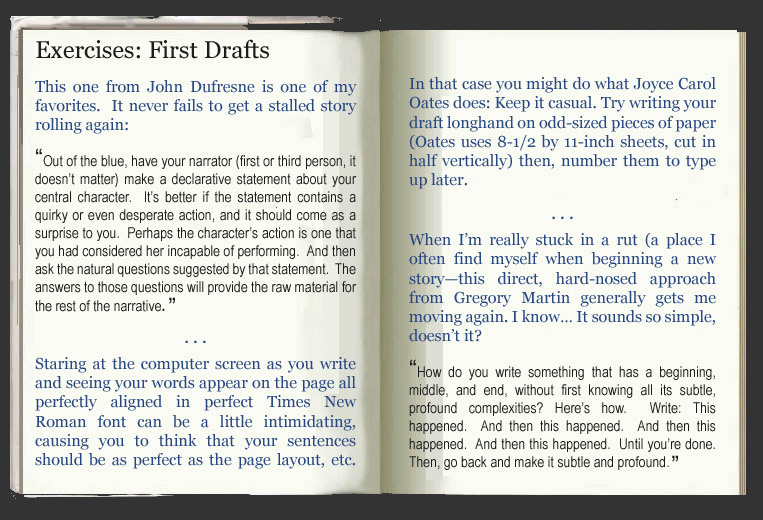
To minimize "first draft" anxiety, Joyce Carol Oates has taken to writing her drafts in long hand using scrap paper. "It's a wonderful way to write, very casual,’ she says. "You don't feel that it's anything too important or too significant.” ["Albany Magazine Stories," Spring 1995, University of Albany]
Perhaps my favorite bit of Dufresne "first draft" advice is the little exercise that follows this post, which can be applied to trouble spots in the second draft as well-- not to mention the third, tenth and fifteenth. I've also listed two others, one from prolific novelist and short-story writer, Joyce Carol Oates; the other from Associate Professor of English at the University of New Mexico, Gregory Martin. Have fun and good luck!
After this post I'll be taking a vacation from blogging in order to freewrite the first three chapters of my old novel (drastically changed story!) I hope you'll join me in this endeavor and write your own first draft of a novel (or like me, the first draft of a drastically changed novel). It would be comforting to know there are others out there struggling to accomplish the same thing.
Hope to see you back here soon!
Will Allison: interviewed for “Writers Ask" (a Glimmer Train publication)
John Dufresne: The Lie That Tells A Truth
Gregory Martin: Gregory Martin: Associate Professor of English, UNM: http://www.unm.edu/~gmartin/
Joyce Carol Oates: interviewed for Albany Magazine Stories, University at Albany, Spring 1995


