Attention struggling, would-be novelists!
Click to listen to a few choice words of wisdom from JCO.
I expect to replay this clip many times over in the coming difficult months...
Leslie
Click here to watch the program in its entirety.
Showing posts with label Joyce Carol Oates. Show all posts
Showing posts with label Joyce Carol Oates. Show all posts
Monday, February 21, 2011
Rough Terrain


Wednesday, January 5, 2011
Happy 2011: First Draft: The Year of Writing Dangerously
* UPDATE (1/28/11): Just finished a draft of chapter two :-) Onward!
Now that the holidays are over, or almost over (the Christmas tree still needs to come down and the ornaments put away) I have an overwhelming urge to write again. How about you? Are you feeling it too? All of a sudden I'm feeling very strong, very brave. I suppose the start of a new year does that to people. In the New Year we give ourselves permission to set aside old fears and strike out in uncharted directions, boldly and unwaveringly, with not so much as a glance behind at the year that was. That's how the New Year starts out anyway, but in recent years, by the end of that first week in January, the old fears return, sneaking up on me like they always do to yank me off course -- back to my old course, that dreaded path of debilitating self-doubt. Have I confessed to you my terror of writing a first draft?
Now that the holidays are over, or almost over (the Christmas tree still needs to come down and the ornaments put away) I have an overwhelming urge to write again. How about you? Are you feeling it too? All of a sudden I'm feeling very strong, very brave. I suppose the start of a new year does that to people. In the New Year we give ourselves permission to set aside old fears and strike out in uncharted directions, boldly and unwaveringly, with not so much as a glance behind at the year that was. That's how the New Year starts out anyway, but in recent years, by the end of that first week in January, the old fears return, sneaking up on me like they always do to yank me off course -- back to my old course, that dreaded path of debilitating self-doubt. Have I confessed to you my terror of writing a first draft?
“The first draft is definitely the hardest,” says author, Joyce Carol Oates, “like hacking one's way through a thick jungle with something like a butter knife.”
Evidently, I’m not the only one who fears the first draft. Author Will Allison, interviewed for “Writers Ask" (a Glimmer Train publication), describes the humbling experience:
“The most difficult part for me is getting a first draft down on paper. I’m not being modest in saying that my first drafts are total garbage. It’s especially hard with a novel—hard to write poorly for so many pages and still think of oneself as doing something worthwhile. I’ve gotten to the point where I tell myself that I’m not even writing, I’m just ‘sketching,’ dumping raw material on the page. That helps take the pressure off. In the end, it’s really just a big leap of faith, believing that it will all eventually amount to something.”
My fear of the first draft has not been completely paralyzing, thank goodness. I've somehow managed to write complete drafts of a fair number of short stories and a sizable chunk (about 3/4) of a 300-page novel, but those "rough" drafts have come at an excruciatingly slow pace. By now I should have completed five novels!
So what is it about writing a first draft that so terrifies some of us? Favorite mentor and author, John Dufresne, answers that question in The Lie That Tells The Truth:
“Writing a first draft isn't easy. It takes perseverance to write a story, it takes that and more to write a first draft. It takes faith and grit, boldness and resilience. It takes poise and good fortune.... You must have the courage to allow yourself to fail. The first draft is where the beginning writer most often finds himself stuck, discouraged, doomed. ”
Faith, grit, boldness! You won't abandon me this time. Not this year. This year things will be different!
The first step to recovery is understanding one's weaknesses. Here, Dufresne describes the troubled novice (me!) to a tee, and how it is we manage to foul things up for ourselves:
“ [The novice writer] makes mistakes. He sets unrealistic goals for what he may not acknowledge to be, but is in fact, the first draft. He undermines his effort by holding unrealistic expectations of his imaginative and organizing powers." [me!] "And so he becomes discouraged when the people in his head are unrecognizable on the page, when the intense emotion he felt in real life is unrealized in what he writes." [me!] "The beginning writer who has read a great deal is even more susceptible to this kind of dejection. She knows that the García Márquez story she just read did not flounder the way hers seems to. She loses confidence and hope, becomes intimidated by the magnitude of the problem that is the nascent story, is humbled by her vaulting ambition. [me, me, me!] "What had seemed like an exciting and noble undertaking now seems foolish and impossible. What she doesn't understand is that García Márquez wrote five hundred pages to get those seventeen. ”
So what advice does Dufresne have for us novices? Those who struggle like me to get that first draft out of our head and onto the page? It's not perseverance and hope I lack, of that I'm certain. I've been working on this novel for almost five years now and I'm still excited about it, still determined to see it through to completion.
“Do not write beyond what the first draft is meant to accomplish. Do not demand or expect a finished manuscript in one draft. (Any writer who tells you he wrote his story in a draft is a liar or a loafer.) The worst thing you can do in writing a first draft is to let your critical self (the boss) sit down at the writing table with your creative self. The critic will always stifle the writer within. And you aught not to be worried about your style or the music of the prose or your word choice-- you make the best word choice you can for now, knowing it'll get better later. Don't even worry about the flow of the plot. You're trying to settle into this new community you've moved to, trying to get to know the people who live there. ”
“If you're having trouble, that means you're thinking. You're being logical, critical. You can freewrite on any emotion, on any character, on any place. If you're stuck, write your character's name on the top of a blank page and freewrite for five, ten, or however many minutes you need to prime the pump. ”
To minimize "first draft" anxiety, Joyce Carol Oates has taken to writing her drafts in long hand using scrap paper. "It's a wonderful way to write, very casual,’ she says. "You don't feel that it's anything too important or too significant.” ["Albany Magazine Stories," Spring 1995, University of Albany]
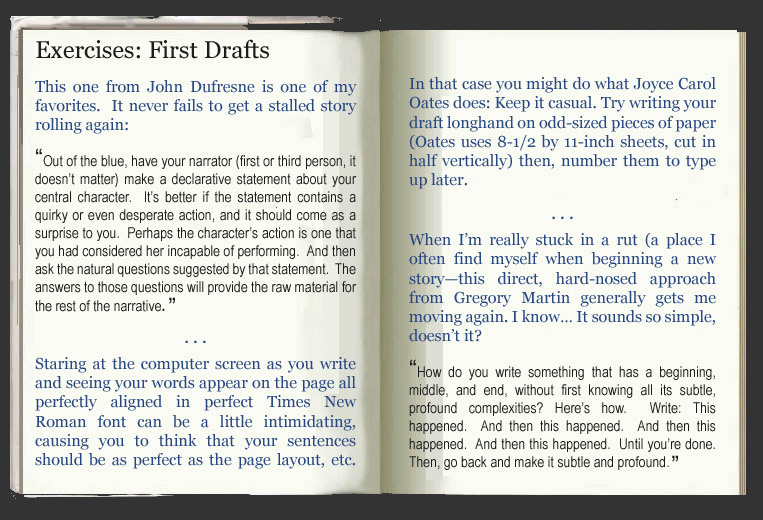
Perhaps my favorite bit of Dufresne "first draft" advice is the little exercise that follows this post, which can be applied to trouble spots in the second draft as well-- not to mention the third, tenth and fifteenth. I've also listed two others, one from prolific novelist and short-story writer, Joyce Carol Oates; the other from Associate Professor of English at the University of New Mexico, Gregory Martin. Have fun and good luck!
After this post I'll be taking a vacation from blogging in order to freewrite the first three chapters of my old novel (drastically changed story!) I hope you'll join me in this endeavor and write your own first draft of a novel (or like me, the first draft of a drastically changed novel). It would be comforting to know there are others out there struggling to accomplish the same thing.
Hope to see you back here soon!
Will Allison: interviewed for “Writers Ask" (a Glimmer Train publication)
John Dufresne: The Lie That Tells A Truth
Gregory Martin: Gregory Martin: Associate Professor of English, UNM: http://www.unm.edu/~gmartin/
Joyce Carol Oates: interviewed for Albany Magazine Stories, University at Albany, Spring 1995
Sunday, May 16, 2010
Yearning
The story I've been drafting for the last two months has finally reached a conclusion, thank goodness, but now it's time to start over and figure out where it went so terribly wrong. About three-quarters of the way in, the story fizzled out. It was missing a key ingredient -- you guessed it: yearning. And without "yearning" the story literally had nowhere to go.
In neglecting to give my main character a strong desire line, I did what many beginning writers do (and some published authors as well). According to Pulitzer Prize-winning author Robert Olen Butler, yearning is as essential to the art of fiction "as color is to painting and movement is to dance and sound is to music." He writes:
 Butler gives us four wonderful literary examples from the works of Janet Burroway, Tom Piazza, Margaret Atwood, and James Joyce, in which the authors depict yearning through "beautiful moment-to-moment sensual details." He goes into great detail about each example, discussing line by line the ways in which the authors build coherence among the details, and how each main character's dynamic yearning begins to manifest itself in his or her particular story. I encourage everyone to get a copy of Butler's book and study that chapter in particular.

Below are examples (not Butler's) of yearning from two very different short stories. The first is from Ryan Boudinot's short story "Cardiology." The protagonist is a boy who lives in a town "where nobody had their own heart. They shared one gigantic heart located in a former water purification plant near the center of town." The young man's yearning is very clearly stated -- to leave town and walk freely -- but not until after we get the a detail-packed description of what it is he'd be leaving behind. The moment-by-moment sensual detail in this piece is probably not what one would describe as "beautiful," but the writing is masterful and the detail makes Magnus's yearning shine forth -- vivid and clear. This passage comes just four paragraphs into the story:


What is it that your character yearns for at the deepest level of his being?

Robert Olen Butler: From Where You Dream: The Process of Writing Fiction
Ryan Boudinot: "Cardiology" at FiveChapters.com
Joyce Carol Oates: "The Lost Brother" in "Zoetrope All-Story", Spring 2005
Tuesday, February 23, 2010
Telling Detail & First Impressions
I was re-reading one of my favorite Hollinghurst novels recently, hoping to somehow absorb through osmosis his exquisite way with language -- ah, those gorgeous sentences! His character descriptions in particular are lovely little works of art: lush, accurate, and insightful; and as Anton Chekhov would most likely say, "rendered with immediate and telling detail." Even his walk-on characters come alive on the page with just a quick, simple stroke of his brush.
In average stories minor characters and walk-ons are often easy-to-forget cardboard placeholders given little attention by their authors. In better stories authors turn simple character snapshots into living, breathing personalities, usually by adding one or two carefully chosen "telling" details (think of them as significant, revealing, or defining details—not to be confused with "show, don't tell") as in these examples from several award-winning authors and literary giants:
= She was fifteen and she had a quick nervous giggling habit of craning her neck to glance into mirrors, or checking other people's faces to make sure her own was all right. [Joyce Carol Oates]
= His eyes were pinpoints of trouble, his mouth a flat line of pain, his shoulders so strong and high that he appeared to have no neck at all. He entered the room as if he'd just been asked to ascend a throne and, after an initial reluctance, now meant to show just how decisive he could be. [Edmund White]
= [He was] very good company but somehow remote, the sort of person it is hopeless to fall for, as I quite did at first, with his hooting laugh and witty sentimental conversation. [Alan Hollinghurst]
= There was something very strange in him; there was a light in his eyes as though of intense feeling--perhaps there were even thought and intelligence, but at the same time there was a gleam of something like madness. [Fyodor Dostoevsky]
= There was a hint of spring in her sloe-green eyes, something summery in her complexion, and a rich autumn ripeness in her walk. [Toni Morrison]
= [He] was geeky, nerdy. His body was a stalk supporting the tulip of his brain. As he walked to the car, his head was often tilted back, alert to phenomena in the trees. [Jeffrey Eugenides]
= He was easily over six feet tall but appeared to regret it. [Edmund White]
= Doa Vicenta, a woman with a dull brain, who when she was not sleeping, was complaining of everything, especially the noise… [Miguel De Unamuno]
= He had on the grey suiting of a business man, but with unusual tucks and vents, which seemed to hint at his role in the arts. [Alan Hollinghurst]
= She had a radish-white, almost raw-looking body and a tiny head made big by puffed-up hair. He never saw her out of her old torn kimono. [Edmund White]
= A priest. A young priest, black-suited, with a black felt hat, one hand stiffly in his jacket pocket, thumb hooked outside, the other holding a black breviary, finger keeping the page. So tall, his head had a stoop. Wire-framed spectacles saddled his nose. Oddly, ever so, foreign-looking. [Jamie O'Neill]
= She recognized most things about him, the tight jeans that showed his thighs and buttocks and the greasy leather boots and the tight shirt, and even that slippery friendly smile of his, that sleepy dreamy smile that all the boys used to get across the ideas they didn't want to put into words. [Joyce Carol Oates]
= He was quite spotty, although probably about my age, and wore hopeless clothes--shapeless jeans, fluorescent trainers and complicated musician's knitwear; but he was beautiful, with his dirty blond hair and chestnut eyes. [Alan Hollinghurst]
= Connie saw with shock that he wasn't a kid either--he had a fair, hairless face, cheeks reddened slightly as if the veins grew too close to the surface of his skin, the face of a forty-year-old baby. [Joyce Carol Oates]
= His ungloved hands, as big and white as boiled hams, hung down at his side. He was wearing a velvet-collared Chesterfield which he'd thrown open as if to breathe more easily, or to cool off, though it was a cold night. [Edmund White]
= He had fair brown hair, with a lock that fell onto his forehead. His sideburns gave him a fierce, embarrassed look… [Joyce Carol Oates]
In Writing Fiction, The Practical Guide (from Gotham Writers' Workshop) Chris Lombardi defines what Chekhov means when he refers to telling detail:
A telling detail does what it says: it tells the essence of what it's describing. Telling details are the scotch tape holding up Susie's hemline in the back, the tiny piece of ice that never seemed to melt in the bottom of Mom's martini, the street sign on the corner that still says, to this day, SCHOOL CROSSING, though the school is long gone. A telling detail can speak volumes in a very short amount of time. They help you achieve a golden mean--enough description to paint the picture, but not so much as to weigh it down.
Brandi Reissenweber, author of the "Ask the Writer" column in "The Writer" magazine, cautions not to use too many details when one or two precisely-chosen details will accomplish the task:
Many writers will pile on details in an effort to capture a character, setting, or moment. This is certainly useful in early drafts, as writers don't often hit on the best details right away. Over describing can be a great way to find telling detail. It's important to go back and pare out what isn't necessary so that the good stuff doesn’t get lost in the clutter.

Joyce Carol Oates, "Where Are You Going, Where Have You Been?"
Chris Lombardi, "Description: To Picture in Words" from Gotham Writers' Workshop, Writing Fiction, The Practical Guide
Brandi Reissenweber, "Ask the Writer"
~
Subscribe to:
Posts (Atom)


