Showing posts with label John Dufresne. Show all posts

Monday, June 3, 2013

The First Scene: Trouble in River City

Today we start our novel.
What will we write about? There can be only one answer.

"There are eight million stories in the naked city, and they are all about the same thing--trouble. Your novel will be about trouble. We're not interested in reading about anything else." - John Dufresne, Is Life Like This? A Guide to Writing Your First Novel in Six Months

So, when should the trouble start? By the first plot point? Ten pages in? Five? Here's another tip from Dufresne (my most trusted advisor, the writer whose guides I turn to over and over again for writing wisdom, motivation, and more than occasional confidence boosts) :

By the end of the first scene "we ought to know what the trouble is, what our central character wants and why, and we should have an indication of what his struggle will be. And we should have a reason for caring about him. You have to make us want to read the next chapter, the next scene."

So here we go. Let's begin. Get out your laptop, your notebook, your napkin--choose your weapon--Let's write the first scene of our novels.


John Dufresne: The Lie That Tells A Truth
John Dufresne: Is Life Like This? A Guide to Writing Your First Novel in Six Months

Friday, July 15, 2011

Beginning Writers

Lazy me... 
Because I haven't had time to post anything new since the beginning of May (!!) I thought I'd offer up this earlier post from January 2010 concerning some of the common mistakes beginning writers tend to make.  Let me know if you've come across any others to add to this list...

A few years ago when I first started writing fiction -- and collecting all those books on the art, the craft, and the joy of writing it -- there was one thing I wanted to avoid more than anything else: making mistakes that only a beginning writer would make. As I read all those writing books a familiar phrase kept popping up over and over again: Beginning writers tend to… (just try googling that string -- it's literally everywherefollowed by a warning that concerned the dreaded something or other that only beginning writers tend to do… Panic set in so I decided to start a list.

This week I thought I'd share with you some of the things that beginning writers supposedly tend to do. The exercise, naturally, is to read over your work-in-progress and make sure you haven't done any of the naughty things on this list:
~
Failure to recognize that the central character must act, not simply be acted upon, is the single most common mistake in the fiction of beginners. [John Gardner]
Beginning writers tend to worry too much about overdoing it. I can't tell you how many times I've looked at a student's work and asked for more detail about this or that – a place, a person – only to be told, "I didn't want to overdo it." Novice writers, just getting their chops, need to worry more about saying enough. [Chris Lombardi, GWW]

Beginning writers tend to use insufficient detail and abstraction where what is needed is concrete detail. [John Gardner]

Beginning writers tend to skimp on the elements of setting and time, probably out of dreary memories of long descriptions they have read… But when atmosphere is well created, we do not experience it as description; we simply experience it. [Janet Burroway]

Beginning writers use this formulaic sentence all too often: "__________ filled the air."The blank can be fear, panic, the scent of cheese, the blare of a marching band. It's part of a larger tendency of description without detail. It's telling and not showing: "…gradually the aroma of coffee filled the air." Nothing fills the air. Do not, under any circumstances, use the  "______ filled the air" sentence structure. [John Dufresne]
Beginning writers tend to forget about the "dynamics of desire" when they create fictional characters. They forget about that epiphany which needs to come "very near the beginning, where the sensual details accumulate around a moment in which the deepest yearning of the main character shines forth." [Robert Olen Butler]

Beginning writers tend to create passive central characters. Boy meets girl. Boy wants girl – good so far. Boy sits by phone waiting for girl to call – not so good anymore. You cannot write a successful story about a passive central character. And you wouldn't want to read one. [John Dufresne]

Beginning writers often try to write novels with a relatively passive protagonist who wants little or has largely given up wanting. I have met more than one writer who says that his character doesn't want anything -- he just wants to "live his life." That always brings to mind something Kurt Vonnegut said: "When I used to teach creative writing, I would tell the students to make their characters want something right away even if it's only a glass of water. Characters paralyzed by the meaninglessness of modern life still have to drink water from time to time." [Sol Stein & Kurt Vonnegut]

Beginning writers have a reticence to use the simple expression: she cried. Instead, we're pummeled with dubious and unnecessary euphemisms: Hot tears leaked from her eyes. Hot tears sprang to her eyes, trickled down her cheeks. Quick tears sprang to her eyes. A single tear ran down her cheek. Big tears, heavy as hail, poured down her cheek. Better: She cried.  And there's no need to say She began to cry. You don't ever have to write the phrase She began anything. She either cried or she didn't. [John Dufresne]

Beginning writers tend to present a main character with a slew of characteristics, when one that is just right would do the job much more efficiently. [Sol Stein]

Beginning writers often have trouble motivating their character's actions. Unfortunately one mention on page sixty-eight isn't going to do it. This is one of fiction's major challenges: making readers understand a character's motives when those motives are not simple. The way you create such understanding is through patterns of incidents. No one occurrence will be enough. [Nancy Kress]
Beginning writers often pad their stories with unnecessary scenes. Study your scene list, trying to eliminate scenes or combine scenes. I've frequently been startled by how much a story can be sharpened by concentrating its events and emotions into the bare minimum of scenes. [Nancy Kress]

Beginning writers tend to use unnecessary flashbacks. While flashback can be a useful way to provide background to character or the history of events – the information that screenwriters call backstory – it isn't the only way. Rather, dialogue, brief summary, a reference, or detail can often tell us all we need to know. [Janet Burroway]

Beginning writers tend to lose sight of their own scenes, letting them drift into flashbacks like Arctic explorers into snowstorms, never to be seen or heard from again. [Peter Selgin, GWW]

Beginning writers tend to unravel the thread of the story instead of keeping it taut like the gut strings of a tennis racket. (Sol Stein).

Beginning writers tend to give far too much background, then compound this mistake by putting the background where it shouldn't go. (Evan Marshall)
Beginning writers tend to shift viewpoint when it is both unnecessary and disturbing. In establishing the story's point of view, you make your own rules, but having made them, you must stick to them. Apart from the use of significant detail, there is no more important skill for a writer of fiction to grasp than this, the control of point of view. [Janet Burroway]

Beginning writers often avoid running straight at an image; that is, the needless filtering of an image through some observing consciousness. Vividness urges that almost every occurrence of such phrases as "she noticed" and "she saw" be suppressed in favor of direct presentation of the thing seen. [John Gardner] *More on "filtering" in the coming weeks…
Beginning writers tend to write dialogue that is too clear, believe it or not. When characters talk too precisely and respond exactly to what has been said, then the words are probably being put in their mouths by the writer. [John Dufresne]

Beginning writers think they know what a character needs to say, and so they don't listen to the characters. They don't want the character screwing up the plot they took so long to devise. And so the character isn't credible. [John Dufresne]

Beginning writers tend to have all of their characters talk the same – usually the way the writer does. (Russell Rowland)
Beginning writers often forget the importance of letting their raw voice lead the story. They start with the voice of the story, often some other writer's story, and hope it will yield powerful, original material. [Thaisa Frank & Dorothy Wall]
Beginning writers often [begin their stories] with strong feelings and ideas without having found the images to embody them. Don't begin with an idea, begin with people, preferably people in action. [Ursula Le Guin & John Dufresne]
Beginning writers sometimes say, "Well, I didn't want to tell what happened to the characters. I wanted to leave the book ambiguous and open-ended. I want readers to decide for themselves what happened." This is usually a response to a criticism that the story feels as if it "just stopped." Unfortunately, the "let-the-readers-decide-for-themselves" stance is usually a failed defense. Readers don't want to decide what happened to the characters. They want you to decide, on the dual grounds that you're the writer and that they've just read four hundred pages of your prose anticipating this very information you're now withholding. [Nancy Kress]
Beginning writers tend to want to dodge the drafting process and write the story immediately. [John Dufresne]

The novice writer sets unrealistic goals for what he may not acknowledge to be, but is in fact, the first draft. He undermines his effort by holding unrealistic expectations of his imaginative and organizing powers. And so he becomes discouraged when the people in his head are unrecognizable on the page. The beginning writer who has read a great deal is even more susceptible to this kind of dejection. [John Dufresne]

On Doing Writing Exercises (something beginning writers do well :-)
When the beginning writer deals with some particular, small problem, such as description of a setting, description of a character, or brief dialogue that has some definite purpose, the quality of the work approaches the professional. [John Gardner, The Art of Fiction]

When the beginning writer works with some sharply defined problem in technique, focusing on that alone, he produces such good work that he surprises himself. [John Gardner, The Art of Fiction]

Writing an exercise, the [novice] writer is in the ideal artistic state, both serious and not serious. He wants the exercise to be wonderful, so that his classmates will applaud, but he is not in the dark psychological set of the ambitious young novelist struggling to write down his existence as it is, with the ghost of the young James Joyce standing horribly at his back.[John Gardner, The Art of Fiction]
~
The following books are available to purchase online:
John Gardner, The Art of Fiction
Thaisa Frank & Dorothy Wall, Finding Your Writer's Voice
Sol Stein, Stein on Writing
Russell Rowland, Gotham Writer's Workshop
Robert Olen Butler, From Where You Dream
Peter Selgin & Chris Lombardi, Gotham Writers' Workshop: Writing Fiction: The Practical Guide

Wednesday, January 5, 2011

Happy 2011: First Draft: The Year of Writing Dangerously

* UPDATE (1/28/11):  Just finished a draft of chapter two :-)  Onward!

Now that the holidays are over, or almost over (the Christmas tree still needs to come down and the ornaments put away) I have an overwhelming urge to write again.  How about you? Are you feeling it too? All of a sudden I'm feeling very strong, very brave. I suppose the start of a new year does that to people. In the New Year we give ourselves permission to set aside old fears and strike out in uncharted directions, boldly and unwaveringly, with not so much as a glance behind at the year that was.  That's how the New Year starts out anyway, but in recent years, by the end of that first week in January, the old fears return, sneaking up on me like they always do to yank me off course -- back to my old course, that dreaded path of debilitating self-doubt.  Have I confessed to you my terror of writing a first draft?

The first draft is definitely the hardest,” says author, Joyce Carol Oates, “like hacking one's way through a thick jungle with something like a butter knife.”

Evidently, I’m not the only one who fears the first draft. Author Will Allison, interviewed for “Writers Ask" (a Glimmer Train publication), describes the humbling experience:

The most difficult part for me is getting a first draft down on paper.  I’m not being modest in saying that my first drafts are total garbage.  It’s especially hard with a novel—hard to write poorly for so many pages and still think of oneself as doing something worthwhile.  I’ve gotten to the point where I tell myself that I’m not even writing, I’m just ‘sketching,’ dumping raw material on the page.  That helps take the pressure off.  In the end, it’s really just a big leap of faith, believing that it will all eventually amount to something.”
                                                                                                                                            
My fear of the first draft has not been completely paralyzing, thank goodness.  I've somehow managed to write complete drafts of a fair number of short stories and a sizable chunk (about 3/4) of a 300-page novel, but those "rough" drafts have come at an excruciatingly slow pace. By now I should have completed five novels!

So what is it about writing a first draft that so terrifies some of us? Favorite mentor and author, John Dufresne, answers that question in The Lie That Tells The Truth:

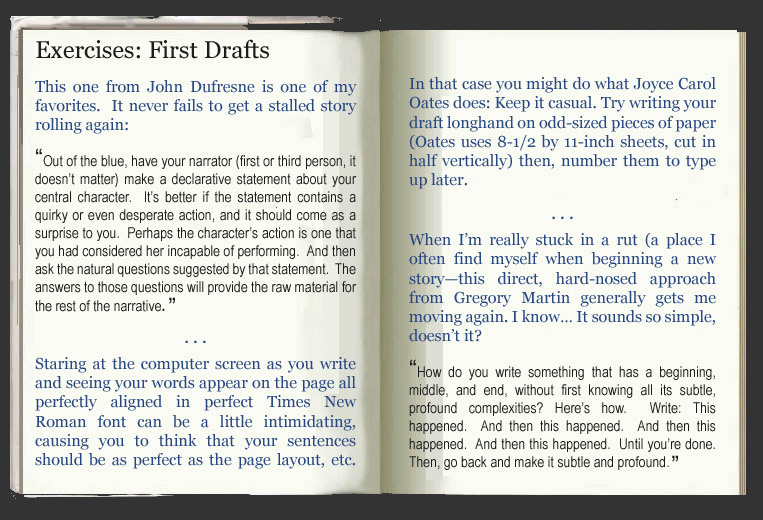
Writing a first draft isn't easy.  It takes perseverance to write a story, it takes that and more to write a first draft.  It takes faith and grit, boldness and resilience.  It takes poise and good fortune.... You must have the courage to allow yourself to fail.  The first draft is where the beginning writer most often finds himself stuck, discouraged, doomed. ”

Faith, grit, boldness! You won't abandon me this time. Not this year. This year things will be different! 

The first step to recovery is understanding one's weaknesses. Here, Dufresne describes the troubled novice (me!) to a tee, and how it is we manage to foul things up for ourselves:

[The novice writer] makes mistakes.  He sets unrealistic goals for what he may not acknowledge to be, but is in fact, the first draft.  He undermines his effort by holding unrealistic expectations of his imaginative and organizing powers." [me!] "And so he becomes discouraged when the people in his head are unrecognizable on the page, when the intense emotion he felt in real life is unrealized in what he writes." [me!] "The beginning writer who has read a great deal is even more susceptible to this kind of dejection.  She knows that the García Márquez story she just read did not flounder the way hers seems to.  She loses confidence and hope, becomes intimidated by the magnitude of the problem that is the nascent story, is humbled by her vaulting ambition.  [me, me, me!] "What had seemed like an exciting and noble undertaking now seems foolish and impossible.  What she doesn't understand is that García Márquez wrote five hundred pages to get those seventeen. ”

So what advice does Dufresne have for us novices? Those who struggle like me to get that first draft out of our head and onto the page? It's not perseverance and hope I lack, of that I'm certain.  I've been working on this novel for almost five years now and I'm still excited about it, still determined to see it through to completion. 

Do not write beyond what the first draft is meant to accomplish.  Do not demand or expect a finished manuscript in one draft. (Any writer who tells you he wrote his story in a draft is a liar or a loafer.) The worst thing you can do in writing a first draft is to let your critical self (the boss) sit down at the writing table with your creative self.  The critic will always stifle the writer within.  And you aught not to be worried about your style or the music of the prose or your word choice-- you make the best word choice you can for now, knowing it'll get better later.  Don't even worry about the flow of the plot.  You're trying to settle into this new community you've moved to, trying to get to know the people who live there. ”

If you're having trouble, that means you're thinking.  You're being logical, critical. You can freewrite on any emotion, on any character, on any place.  If you're stuck, write your character's name on the top of a blank page and freewrite for five, ten, or however many minutes you need to prime the pump. ”

To minimize "first draft" anxiety, Joyce Carol Oates has taken to writing her drafts in long hand using scrap paper. "It's a wonderful way to write, very casual,’ she says. "You don't feel that it's anything too important or too significant.” ["Albany Magazine Stories," Spring 1995, University of Albany] 

Perhaps my favorite bit of Dufresne "first draft" advice is the little exercise that follows this post, which can be applied to trouble spots in the second draft as well-- not to mention the third, tenth and fifteenth. I've also listed two others, one from prolific novelist and short-story writer, Joyce Carol Oates; the other  from Associate Professor of English at the University of New Mexico, Gregory Martin.  Have fun and good luck!

After this post I'll be taking a vacation from blogging in order to freewrite the first three chapters of my old novel (drastically changed story!)  I hope you'll join me in this endeavor and write your own first draft of a novel (or like me, the first draft of a drastically changed novel). It would be comforting to know there are others out there struggling to accomplish the same thing.

Hope to see you back here soon!

Leslie
~
Will Allison:  interviewed for “Writers Ask" (a Glimmer Train publication)
John Dufresne: The Lie That Tells A Truth
Gregory Martin: Gregory Martin: Associate Professor of English, UNM: http://www.unm.edu/~gmartin/
Joyce Carol Oates: interviewed for Albany Magazine Stories, University at Albany, Spring 1995

Tuesday, November 16, 2010

Part VIII: PLOT: John Barth and his Incremental Perturbations

***This post is the last in a series of eight exercises designed to take our short stories from rough draft to finished "masterpiece"(or as close as we can get ;-) with the help of the late John Gardner and a host of other well-known authors and teachers.  Click here for Part I ***


You’re probably scratching your head right now wondering why on earth I saved “plot” for last, and you’re probably right to wonder about that. Maybe back in August (when we began the work of turning the first drafts of our short stories into unforgettable masterpieces) we should have begun our revisions by studying plot before we talked about all those other things-- like dialogue, structure, setting, and emotion, or how to engage readers using authenticating detail.  

Well, if there’s one thing I’ve learned about writing fiction, it’s that no matter how hopeless or unwieldy the task may seem, it’s never too late to fix a troublesome passage—or even an entire manuscript, if that's what's required.  If we’ve taken the time to introduce our characters and delineate their myriad flaws, fears, and emotions, and to fill their little mouths with crackling, subtextual dialogue… And we’ve gone through all the effort to create vivid, dynamic descriptions of the settings they inhabit, why would we not invest the time necessary to tell our story in the most compelling way we can—no matter how many revisions it takes—until we’re satisfied that the story on paper is as good or better than the one that originally took shape in our heads?

“Though character is the emotional core of great fiction, and though action with no meaning beyond its own brute existence can have no lasting appeal, plot is—or must sooner or later become—the focus of every good writer’s plan.”  Wise words from the late John Gardner, novelist and creative writing teacher, and our mentor for this series of short story exercises.

So what is plot, exactly? And how can we apply it to the draft of a story we’ve already written (and in fact have already been revising for the last three months)?  First, a definition of plot from a few of my favorite mentors:

From The Lie That Tells A Truth by John Dufresne:  “An idea is not a story.  A first draft is not a story.  A moral is not a story.  A character is not a story.  A theme is not a story.  A plot—now, that’s a story! So where do I get me one? you might ask. At your writing desk.  Because plots don’t exist.  They can’t be shopped for or ordered on-line.  They are coaxed into being.  They develop.  They grow in the course of the writing.  A plot begins to form as soon as you begin to ask yourself the appropriate narrative questions: What does my central character want? What is preventing her from getting it? What does she do about the various obstacles in her way? What are the results of what she does? What climax does this all lead to? Does she get what she wants in the end? Plot, then, is the element of fiction that shapes the many other elements—character, theme, point of view, language, and so on—into a story.  It’s the organizing principle of narration, let’s say. […] Plot is the force that holds the universe of your story together.”

From Fiction Writer’s Workshop by Josip Novakovich: “If you don’t write from an outline, once you have finished a story, you still should be able to see its outline, the way after a touchdown it’s easy to draw a chart of what happened in the play.  Something must happen, and in the end, we must know why it has happened.  Plot is partly what you discover in the writing of a story, not what you “insert.” You raise questions and seek answers, connect your sentences into paragraphs, paragraphs into chapters, chapters into novels.  This thread of investigation may be a thin one, but you must have it to give yourself and your readers something to look for.”

From Brandi Reissenweber in her lecture on “Plot & Structure”: “Structure and plot are the architecture of storytelling. The façade of a building may be beautiful, brilliant, breathtaking even, but it can only be that way if it is standing, right? That’s where these foundational elements come in. All other aspects of fiction—characterization, description, what distinguishes your voice from others,—hang on the basic structure and plot of the story.”

John Barth, noted novelist, short story writer, and witty professor of creative writing, writes that “Dramatic effect, not linear chronology, is the regnant principle in the selection and arrangement of a story’s action,” that “a story’s order of narration need not be the strict chronological order of the events narrated.”

However we decide to arrange the “action” in our stories, that action traditionally includes the six ingredients below. [Bracketed explanations are capsulated passages from “Incremental Perturbation: How to Know Whether You’ve Got a Plot or Not,” an essay by John Barth. To learn more, and to understand his "systems analysis" theory on the workings of plot, read Barth's classic (and humorous!) essay in Creating Fiction]:

1.  Status Quo: [the less-than-stable “Ground Situation.” An overtly or latently voltaged state of affairs preexisting the story’s present time; one that tends to regulate itself toward equilibrium but is essentially less than stable (otherwise there would be no story). The Montagues and Capulets have been hassling each other in Verona for a long time before the story begins: a taunt here, a street scuffle there, but nothing the two families can’t quite absorb.  No ground situation, no story, however arresting the action to come, for it is its effect upon the ground situation that gives the story’s action meaning.]

2.  The Inciting Incident: [A present-time turn of events that precipitates a story out of the ground situation… “And then one day,” as the narrative formula puts it, the dramatic vehicle rolls into town: Young Romeo Montague falls for young Juliet Capulet, and vice versa.] 

Note: David Harris Ebenbach of Gotham Writers Workshop says it’s the responsibility of the writer to begin the story at the point of change (the inciting incident), when “something’s happening that stands out.” Take Raymond Carver’s “Cathedral” for example.  Carver didn’t begin his masterpiece “a few weeks earlier, when nobody was coming to visit.  [He began with] the day that’s the focus of the whole piece.”  In order to “drop the reader right into the middle of the action” and almost simultaneously provide him with the necessary information to set up the ground situation (exposition), you’ll have to work hard to strike just the right balance.

3.  Complications (escalating conflict): [Incremental perturbations of the ground situation; the successive complications of the conflict. (The star-crossed lovers declare their love, but…) In the story’s middle these “perturbations” follow not only upon one another but from one another, each paving the way for the next (as the story’s middle performs its double and contradictory functions of simultaneously fetching us to the climax and strategically delaying our approach thereto)]

4.  Climax: [A comparatively sudden and consequential effect triggered by comparatively small incrementations, like an avalanche, or the click of the thermostat—whether or not it involves the fall of the mighty from the height of fortune to the depths of misery.  Even in the most delicate of epiphanic stories, the little insight vouchsafed to the protagonist (or perhaps only to the reader), the little epiphany that epiphs, does so in a comparative flash—and, for all its apparent slightness, is of magnitudinous consequence]

5.  Denouement: The consequence of the complications and climax. [measured by the net difference it effects in the ground situation.  If nothing of consequence about the ground situation has been altered, no story has been told…. The equilibrium of a story’s denouement is not that of its opening: The surviving Capulets and Montagues are sadder but perhaps at least temporarily wiser in the “glooming peace this morning with it brings.”  It is an equilibrium complexified, qualitatively changed even where things may appear to all hands (except the reader/spectator) to be back to normal.  Otherwise, what we have attended may have its incidental merits, but, for better or worse (usually worse), it’s not a story].

6.  Wrap-up [the little coda, closing fillip, or dolly-back shot often appended to the denouement like a jazz drummer’s “roll-off” at the end of a number, and usually suggestive of what the story’s completed action portends for the principal characters].


John Gardner: The Art of Fiction

Josip Novakovich:  Fiction Writer’s Workshop

Brandi Reissenweber: Instructor, Gotham Writers' Workshop, and author of the "Ask the Writer" column for "The Writer" magazine. Be sure to check out "Letterpress," her wonderful blog on the craft of fiction.

David Harris Ebenbach: The chapter "Plot: A Question of Focus" in Gotham Writers' Workshop: Writing Fiction, The Practical Guide (also contains the full version of "Cathedral" by Raymond Carver)


Part I: Introduction
Part II: Setting & Emotion  
Part III: Character Motivation & Change
Part IV: Story Shape
Part V: Dialogue
Part VI: Authenticating Detail & Description
Part VII: Tension & Reader Anticipation

Wednesday, October 27, 2010

November: 30 Days of Writing Bliss

Well, I'm supposed to be posting the final exercise in my series of short story writing exercises today, and I was just sitting down to do that when a friend e-mailed with an important reminder:  It's October 27th, which means NaNoWriMo begins in just 5 days!

I posted about this a year ago, so instead of wasting time writing about it all over again I'll just copy, paste, and tweak my post from last year, and that way while you're checking it out to see what all the November fuss is about, I'll slip away to finish up Part VIII of the short story posts.  Meet you back here in just a few days...

From October 2009:

I can't believe it's here again so soon!  If you don't know what I'm talking about, it's National Novel Writing Month (NaNoWriMo) -- 30 caffeine-filled days of writing pleasure and frenzy in which participants write 1,667 words per day with the goal of completing a 50,000-word "shitty" first draft by midnight on November 30th.  Are you up for that? Are you ready to go??

There are so many ways to tackle this thing: 

l If you're a planner like me, you might prepare a detailed map either outlining or making lots of notes about every chapter and every scene, with a character chart delineating each character's growth and change throughout the entire novel -- a master plan so to speak, so you'll know where you're going and how you plan to get there.  My advice is to print out your plan and pin it to the wall next to your laptop.  That way you'll have it to refer to whenever you get stuck, which if you're like me will happen quite often. 

l  If you're like some of my successful NaNo friends, you begin on November 1st with nothing but the seed of an idea germinating in the soft tissue of your brain.  The idea here is to sit yourself down in front of your computer and imagine a character or two, listen to what they tell you, and hope that their words trickle down from your brain to your fingertips. If you're lucky, you'll end the month like my friends have, with something unwieldy, surprising, and magnificent -- a rough first draft to take you through the rest of the year and possibly beyond.  That's when you'll apply structure and plot to shape the story into something compelling and meaningful. 

Flannery O'Connor liked to work that way.  She once said: "If you start with a real personality, a real character, then something is bound to happen; and you don't have to know before you begin.  In fact, it may be better if you don't know what before you begin.  You ought to be able to discover something from your stories."

l  Of course you can always use a combination of these two methods.  Ansen Dibell, author of Plot, calls this writing method "Outlining from Inside":

"Stories -- especially live, convincing stories -- will change under your hands.  That's the reason I've never been persuaded of the usefulness of outlines.  By other writers' experience and my own, I judge that you generally won't know how a story's going to go until you get close to the place where something is just about to happen.  It will take its own shape and tell you how it wants to go, if you listen and watch attentively for the ways it's telling you. 
            "My advice is that you should always know what your next set-piece is going to be." [Dibell defines a set-piece as "a big scene the reader can see coming and can look forward to awhile, either in fear or in hope, before it's reached."] "You should be laying the groundwork for it right up to the time it happens.  You should start that groundwork either from the story's beginning, or lay down the first seeds back before the previous set-piece, to mature and bloom later."
            "When you've written your set-piece, you should be looking ahead to the end, to see if you can see its shape any more clearly from this vantage point than you could before.  And if you can, make adjustments to make this scene lead more clearly, more precisely, toward the last cliff, with fewer possible turnings-away, so that the story, crisis by crisis, narrows down to a point that seems inevitable when it comes. 
            "I call it outlining from inside.  Blocking out the story, one set-piece at a time, from inside it, taking due account of what it seems so far to be trying to become.  That much outlining, I believe, every writer needs if his story is not to appear a funhouse, a random series of events sprung on the reader for no particular reason, gone too fast to have impact, leading from nothing to nothing.  You need some kind of an outline, some idea of where you're going and how, if you're going to keep your story out of the funhouse which, in fiction, is no fun at all.  Look ahead at least to your next major scene and get ready for it.  Then deliver."
           

l   Another method I've heard about (but never tried myself) is the "Snowflake Method" developed by Randy Ingermanson, physicist and author, in which you begin by writing a one-sentence summary of your novel in 15 words or less. You turn this little snow-crystal into a snowflake (and finally, a snowball) by rolling it through the snow-fields of your mind where hopefully it picks up more and more ice-crystals during each pass.  By November 30th at midnight you should have a massive and intricate snowball full of well-developed characters, detailed settings, and compelling dialogue.  It goes something like this:
            1.  Write the summary sentence of your story in 15 words or less.
            2.  Expand this sentence into a 5-sentence paragraph: one sentence for the story setup, one sentence for each of three "disasters" that take place during your novel, ideally each disaster worse for the protagonist than the last.  The last sentence  tells the ending.
            3.  Expand each sentence of your summary paragraph into a paragraph of it's own, fleshing out some of the disasters in your summary paragraph above.
            4.   Expand the one-page plot synopsis into a 4-page synopsis… etc., etc., etc.

You get the picture. Actually, it's much more detailed than that, and may be just what you need to organize your thoughts and turn them into a well-oiled page-turner.  You can get all the background information, and Randy Ingermanson's "Ten Steps of Design" at AdvancedFictionWriting.

Anyone who's ever NaNo'd successfully will tell you that every writer has a slightly different method of reaching that 50,000-word goal by the end of November.  All I can tell you is what worked for me.  

Here's just the thing to help get you started.  It's a great little exercise from John Dufresne's wonderfully encouraging book on writing fiction, The Lie That Tells A Truth.  (Might be a good one to read in preparation for November 1st…)  The exercise below will not only get you thinking about the beginning of your novel, but will come in handy whenever you're ready to begin that next big scene.

If you haven't already signed up for National Novel Writing Month, I urge you to do it now, before it's too late. You'll have the time of your life and you'll end up with a writing project to take you through 2011 and beyond :-)

Good luck!

An exercise from John Dufresne to get you started:


John Dufresne is professor of creative writing in the MFA program at Florida International University in Miami, and author of The Lie That Tells A Truth, a Guide to Writing Fiction.  He has also authored four novels, and at least two short story collections that I know of.