Showing posts with label John Mullan. Show all posts

Friday, July 2, 2010

He Said, She Said: Free Direct Speech


For this exercise I'm stealing a passage from John Mullan's analysis of Jonathan Safran Foer's novel Everything is Illuminated, which was part of Mullan's 2005 "Elements of Fiction" series in "The Guardian": 

Mullan's article continues (you can read the rest of it here).

Although these days, free direct speech is apparently "only proper if we are to listen to something truly incomprehensible", I'd like to try using the technique to stretch and strengthen those (my) flabby dialogue-writing muscles a bit.


· John Mullan is senior lecturer in English at University College London. Read his archived pieces and respond to them at http://books.guardian.co.uk/elements/0,,1427415,00.html

Monday, June 21, 2010

Take Your Character to the Movies...

Last month, as part of his long-running "Ten of the Best: Highlights From the World of Literature" series in The Guardian, John Mullan gave us "Ten of the Best Visits to the Cinema in Literature." The movie-going characters in these scenes come to life in novels by Thomas Mann, Hermann Hesse, and Kazuo Ishiguro, to name just three.  Also on the list is the 2004 Man Booker Prize-winner The Line of Beauty by British novelist Alan Hollinghurst, one of my own personal favorites. 

So what makes these scenes so great?  And why couldn't one of our own movie-going protagonists make it onto a list like this someday?

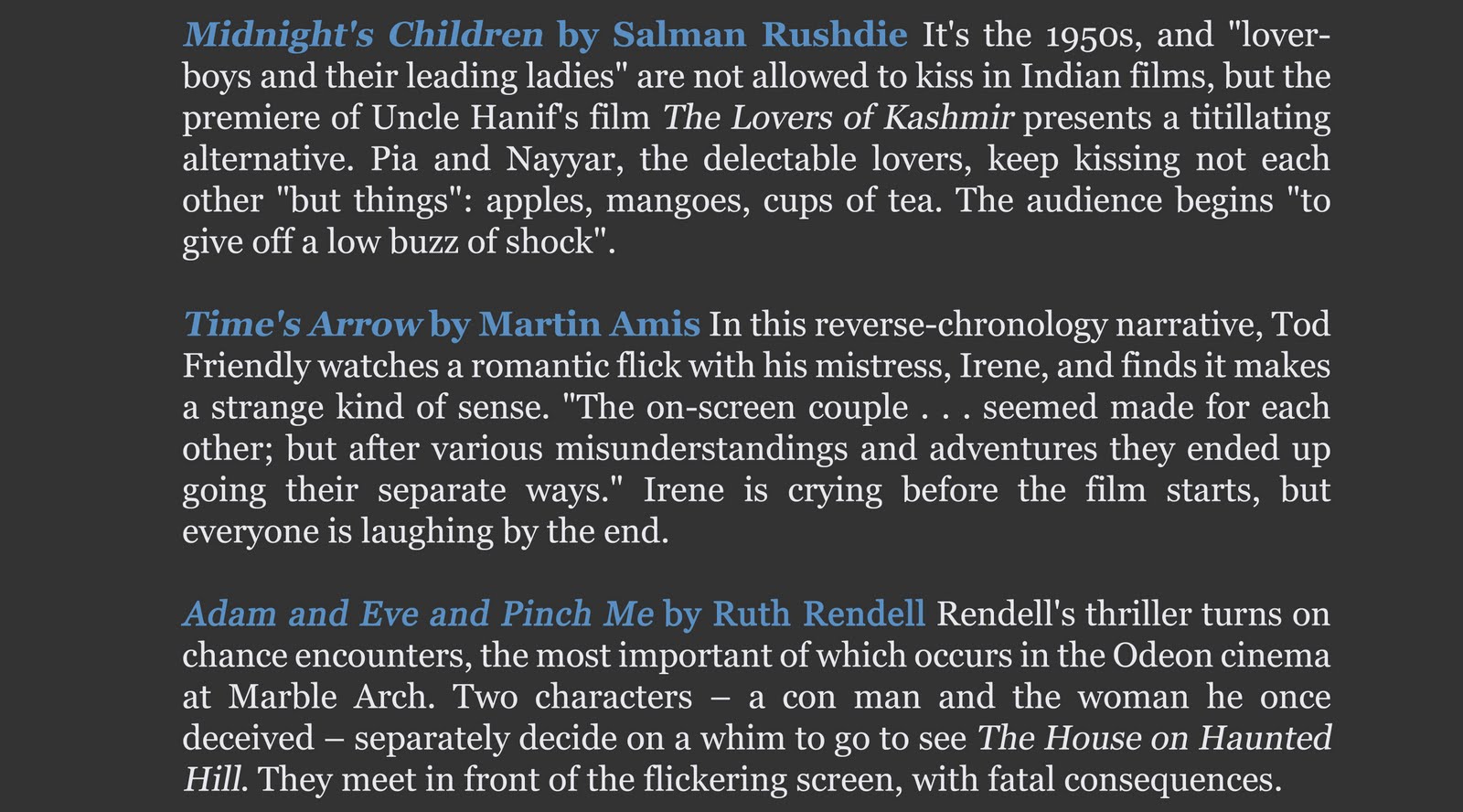
When you read through Mullan's ten-of-the-best list below you'll notice that the scenes have more in common than just the fact that they're set inside a movie theater. The characters in these scenes act in unique and unpredictable ways, surprising the reader with their thoughts and reactions to what they see on the screen.  The characters discover things about themselves or society based on the films they see or the audience reactions to them.  The writing styles vary widely but in every passage the language sings in its own way, some crisp and others lush, but most rich in specificity and sensual detail.  Following are John Mullan's "ten of the best" and his description of each:
  
John Mullan: "Ten of the Best Visits to the Cinema in Literature" guardian.co.uk, May 15, 2010